Showing posts with label Indian Vegetables. Show all posts
Thursday, July 9, 2015
Shevga Palebhaji - Drumsticks Leaves Stir Fry
I try to include some leafy greens or the other at least 3 times a week. During winter, I just use frozen collard greens, turnip greens or spinach. But now it's spring turning into summer. Farmers markets and Indian stores bring in some exotic leafy greens. This is the best time to eat fresh greens.
Shevgyachi Paaleybhaji
Ingredients
1 bunch tender drumsticks greens, rinsed, roughly chopped
1/4 cup yellow moong daal, soaked for 2 hours
salt to taste
Tempering
1 tsp oil
1 shallot or small onion, finely chopped
4-5 garlic cloves, peeled and chopped or slivered
A pinch of turmeric powder
2 red chilies
2 green chilies
Garnish
1/4 cup freshly scraped coconut
Method
1. Chop drumsticks leaves and stems - if they are tender. Chop the onion.
2. Heat oil in a saucepan. Sauté garlic and pinch of turmeric till garlic changes its colors. Add chilies and shallot. Sauté till onion is soft.
3. Add drained moong daal. Sauté for 5 minutes.
4. Add chopped drumstick leaves. Sprinkle some water. Mix.
5. Cover with a lid. Pour water on the lid.
6. Let it cook till soft.
7. Add salt to taste and coconut.
Note -
1. This bhaji needs more coconut than usual.
2. Use more or less chilies per personal preference.
Print Page
Tuesday, July 7, 2015
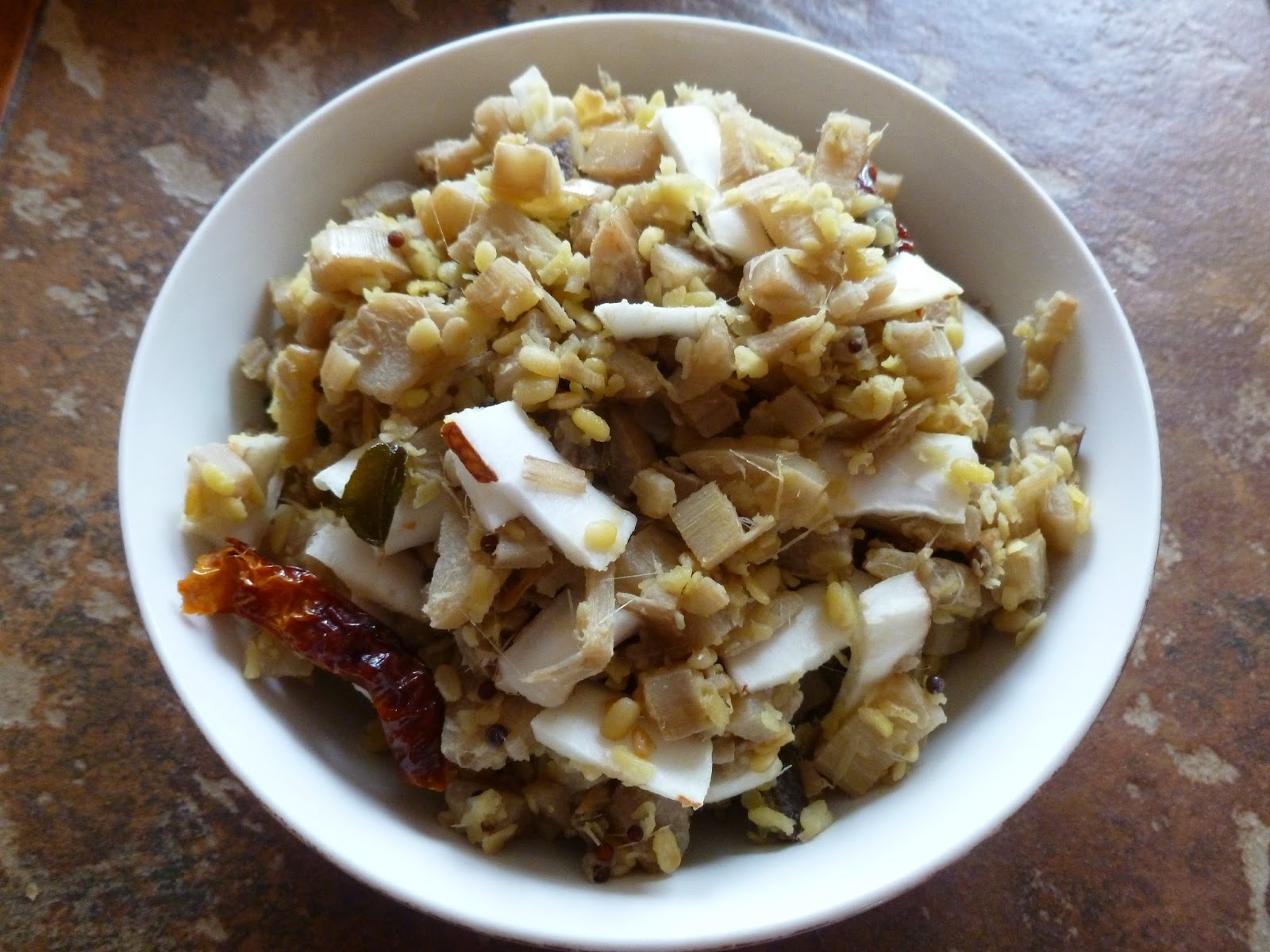
KeLya Gabbya Upkari - Banana Stem Stir Fry
When I wanted to blog about Sanjimaayi's KeLya Gabbya Kochcholi, I substituted banana stems with Hearts of Palm from the can. I had thought then, that I would need to make a trip to Matunga, Mumbai to get the fresh banana stem. But never in my wildest imagination, I had thought of getting fresh banana stem right here in my city.
I was overjoyed to see it and wasn't even sure if I would know how to cut it. But the shop owner told me what needs to be done.
KeLya Gabbya Upkari
Banana Stems Stir Fry
Ingredients
1 banana stem, peeled & chopped about 2 cups
salt to taste
1/4 cup yellow moong daal, soaked for 1/2 hour
Tempering
1/2 tbsp. coconut oil
1/2 tsp mustard seeds
1/2 tsp asafetida
3-4 byadgi chilies, halved
2 springs curry leaves, torn
Garnish
A generous handful of scraped coconut
Method
1. Take a banana stem and give a gash to peel off outer layer till you get the inside banana stem. Please see the cross section of the banana stem. You need to get rid of at least 2 layers to get inside the stem.
2. Dice the peeled, tender banana stem into small pieces. It should be cut smoothly. Otherwise if it is too rough to be cut, discard the piece.
3. Put the diced banana stem into a buttermilk to avoid discoloration.
4. Heat oil in a saucepan/kadhai/bogaLe. Add the spices and chilies. As they splutter, add soaked moong daal. Stir fry for 30 seconds. Add drained banana stem pieces. Discard the buttermilk.
5. Cover with a lid. Pour water onto the lid. Let it cook.
6. Add salt to taste.
7. Garnish with scraped coconut or coconut pieces.
Note -
1. I used coconut pieces instead of scraped coconut.
2. Instead of moong daal, chana daal can also be used.
Banana Stem/KeLya Gabbo
Print Page
Friday, July 3, 2015
Shevgyache Daangar - Drumsticks Leaves Fritters
Drumsticks leaves and flowers are devoured in Malvani/Konkani cuisine. When I got these precious leaves at our local Indian stores, I knew right away that I would make bhaaji and daangars.
Shevgyachya Paananche Daangar
Drumsticks leaves fritters
Ingredients
1/2 cup drumsticks leaves, roughly chopped
1/2 cup chickpea flour
2 tbsp. rice flour
1 shallot, finely chopped
1 tsp ginger-garlic paste
1 green chili, minced
salt to taste
1/2 tsp turmeric powder
1/4 tsp asafetida
1/2 tsp chili powder
Oil for shallow frying
Method
1. Mix chopped leaves, chili and shallot.
2. Add flours, salt and dry spices. Mix.
3. Add ginger-garlic paste.
4. Add water as needed to make a thick batter.
5. Heat tawa. Pat small ball of dough. Drizzle oil as needed.
6. Flip and let it brown on both sides.
Note -
1. This is served as a side dish with daily meal.
2. Omit green chili if you don't care for biting into chili pieces.
Print Page
Wednesday, June 17, 2015
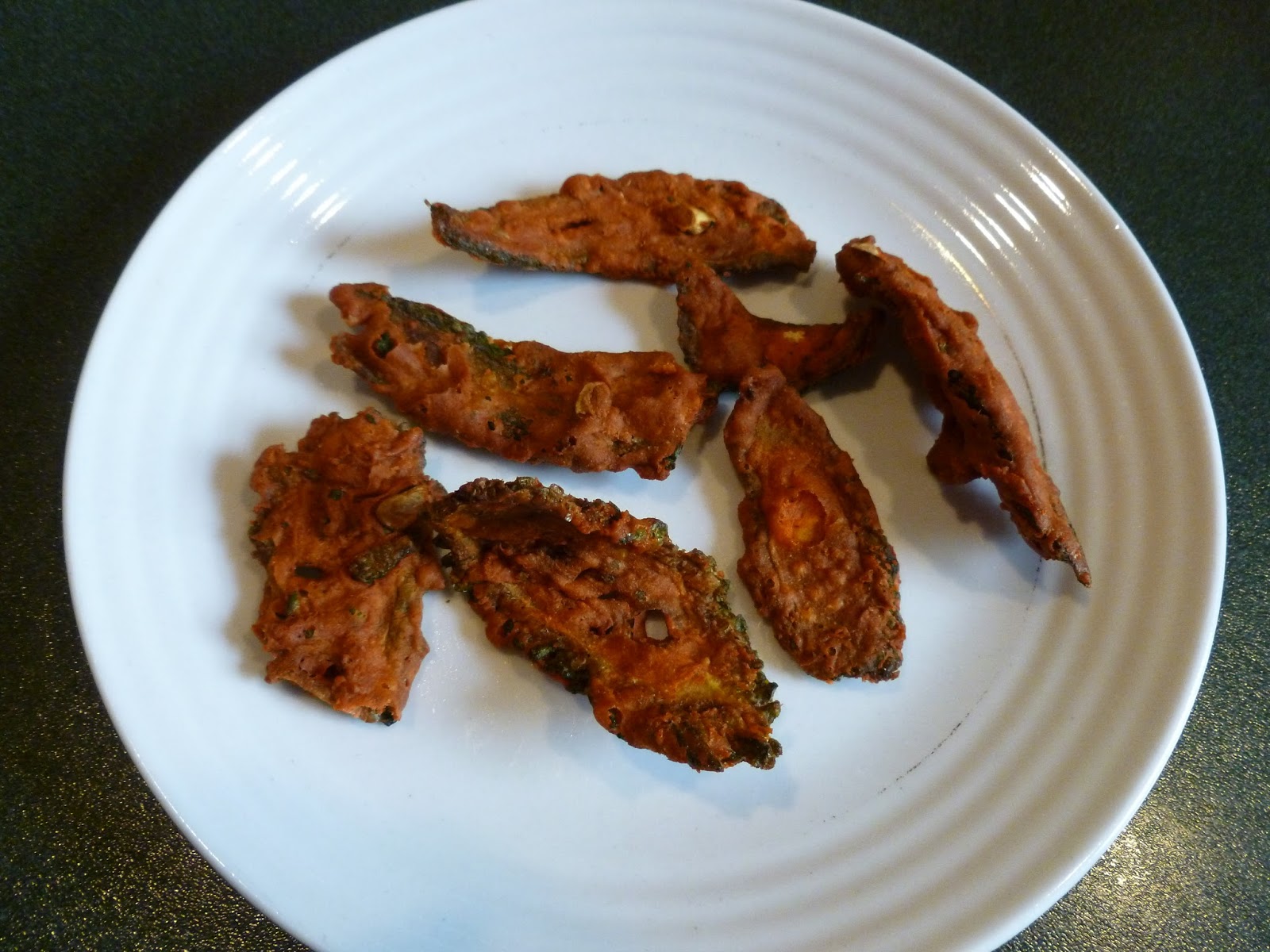
Karlyachi Bhuji - Bittergourd Fritters
I made these simple bitter gourd fritters after tasting them in Mumbai.
Karlyachi Bhuji
Bitter gourd Fritters
Ingredients
3 small bitter gourd, scraped, deseeded, cut into 4-6 pieces, lengthwise
salt to taste
1/2 cup rice flour
1/2 tsp turmeric powder
1/2 tsp asafetida
1 tsp chili powder
Oil for frying
Method
1. Scrape the peels and remove the seeds of the bitter gourds. Cut them into 4-5 pieces lengthwise.
2. Apply salt and set aside. Drain the bitter gourd slices after 15 minutes.
3. Heat oil for frying.
4. Mix rice flour with spices. Add water to make a thick batter. Adjust salt - remember that you had applied salt to the bitter gourd pieces.
5. Dip each bitter gourd piece into the batter to coat it uniformly. Shake off any excess.
6. Place into hot oil. Fry till crispy on both sides.
7. Place on a kitchen napkin to remove excess oil.
Note -
1. Add more or less chili powder depending on your preference.
Print Page
Thursday, June 11, 2015
Hurdyache ThalipeeTh
My mom had been to Mahalakshmi Saras Exhibition at Bandra Reclamation ground with her friends. They tasted delicious "HurDyache ThalipeeTh". I really thought that it was an amazing idea to try. But getting "HurDa" here is United States was impossible - or so I thought.
Last week, I couldn't believe my eyes when I spotted "Ponk" made by Deep Brand in the frozen section. What we call "hurDa" in Marathi(हुर्डा ) , Gujaratis called "Ponk" (પોંક ) - it's fresh, green tender grains of Sorghum/Jowar/Jondhala/Jwari.
Deep's description says -
"
As delicious as it's rare, Ponk is known in Western India as a special treat - available during short time during winter months. Ponk is lightly roasted so as to retain its tenderness and moisture. Traditionally mixed with tangy sev, Ponk is a perfect snack.
"
Every winter, you get fresh ponk/hurDa in certain parts of Mumbai. I remember my aunt would make that special trip all the way to Dadar - near Kabutar khana - to get that fresh ponk. It was sprinkled with chaat masala and crispy sev.
I took that ponk from the freezer section, thaw it completely at the room temperature, used the bhajni from my pantry and made this thalipeeth. It was delicious.
Disclosure - I am not affiliated to Deep food products by any means. I am just sharing my excitement about finding a rare childhood winter treat right here in the US of A.
Hurdyache ThalipeeTh
हुरड्याचे थालीपीठ
Green Sorghum Grains Pat a cake
Ingredients
1 cup green sorghum grains/HurDa/Ponk
1 1/2 cups Thalipeeth Bhajni
3/4 cup minced onion
1/3 cup chopped cilantro
salt to taste
oil for frying
Method
1. If using "Ponk" from the frozen section, thaw it completely at room temperature.
2. Mix it with bhajni, onion, cilantro and salt.
3. Add water as needed to make little loose dough.
4. Heat a cast iron or nonstick griddle.
5. Keep a bowl of water ready to wet your hands from time to time.
6. Take a ball of the dough with wet hand, place it gingerly on the hot pan. Start patting with your wet hand till it's flat, round and thin.
7. Mark 4-5 holes using the back of a spoon.
8. Drizzle oil as needed around the thalipeeth and into the holes.
9. Cover and let it cook on medium heat.
10. Remove the lid. Flip and let it crisp up on the other side.
11. Serve hot thalipeeth off the pan immediately.
Note-
1. ThalipeeTh bhajni generally contains all the necessary spices, but if you like it, you can add more chili powder or ginger-garlic paste depending on your preference.
2. Thalipeeth bhajni generally does not contain salt. However, make sure it doesn't have it first, and then add salt accordingly.
3. Traditionally thalipeeth is served with a dollop of homemade butter/loNi. But this recipe is otherwise very much vegan!
4. I used Ponk - Deep brand - from the freezer section of my local Indian stores.
Print Page
Tuesday, June 9, 2015
Panchkutiyu Shaak
My mom-in-law was a working woman. (She is now retired). So many of her recipes involved using pressure cooker since it makes food gets cooked in a jiffy. Today's Panchkutiyu shaak recipe is also a pressure cooker based, but it can easily be made in a saucepan. Cooking time may increase as it will need to be cooked on a low flame.
Panchkutiyu Shaak
Ingredients
4-5 small eggplants, Make a 'X' slit on each
4-5 small potatoes, make a 'X' slit on each
1/2 cup surti papdi lilva/baby lima beans
1 green banana, cut into big chunks, and make 'X' slit on each chunk
1 sweet potato, cut into big chunks, and make 'X' slit on each chunk
Mix
1 cup chopped cilantro/coriander leaves
1 tbsp. dhana jiru/coriander-cumin powder
1 tsp ginger - green chilie paste
1 tsp garlic paste
salt
1 tsp Gujarati Garam Masala
1/2 tsp turmeric powder
1/2 tsp chili powder
1 tsp sugar (optional)
Tempering
1 tbsp. oil
1/4 tsp ajmo
1/2 tsp turmeric powder
1/4 tsp asafoetida
Method
1. Heat oil in a pressure cooker.
2. Add ingredients for tempering.
3. Add beans at the bottom. Place stuffed vegetables. Spread all the remaining stuffing over the vegetables.
4. Pour about 1 cup water.
5. Pressure cook till done.
6. Remove pressure.
7. Simmer till cooked. Add more water if you desire more gravy.
Note -
1. Make sure that there is extra stuffing after stuffing the vegetables.
2. I sometimes add some readymade hard muthiyas that are available.
3. This shaak can also be made without pressure cooker. In that case, cover the saucepan with a lid. Pour some water on top. Let it cook for about 30 minutes or till the vegetables are done. Cook on low flame.
4. If made without pressure cooker and want to use readymade, hard muthiyas , soak them for 10 minutes before using.
Print Page
Tuesday, March 3, 2015
Karate Bilimbi Ghasshi
Karate Ghasshi is an exception to the definition of the "Ghasshi" in South Canara culinary glossary. Every ghasshi has a tempering of mustard seeds and curry leaves, but it never has jaggery.
Karate Bilimbi Ghasshi
Ingredients
3 karela/karli/bittergourd, scraped, deseeded, chopped
1/2 tsp turmeric powder
7-8 Bilimbi, lightly crushed
salt to taste
2 tbsp. jaggery or to taste
Grind
1/2 cup fresh coconut
1 tsp urad daal, roasted
1 tbsp. coriander seeds, roasted
6-7 fenugreek seeds, roasted
5-6 byadgi chilies, roasted
Tempering
1/2 tbsp. oil - preferably coconut oil
1/2 tsp mustard seeds
2 sprigs curry leaves, torn
Method
1. Add bitter gourd, bilimbi and turmeric powder in a saucepan. Add 1/4 cup water. Cook on a medium flame.
2. Roast coriander seeds, urad daal, chilies and fenugreek seeds. Grind along with coconut, adding water as needed.
3. Pour this ground paste into the bitter gourd mixture. Add 1/2 cup water. Bring to boil. Add salt and jaggery.
4. Simmer till it reaches thick consistency.
5. In another small saucepan, heat coconut oil. Add mustard seeds and curry leaves.
6. Drizzle this tempering over the curry. Cover with a lid. Switch off the gas.
Note -
1. The same curry can be made with raw mango or ambado instead of bilambi.
Print Page
Friday, February 27, 2015
Breadfruit & Peas Curry
Vilayat means foreign in Marathi. So Vilayati Fanas means foreigner jackfruit which is otherwise known as breadfruit in English. Fresh breadfruit is available in many south American stores or it's also available in the frozen section of Indian stores.
Vilayati Fanasachi bhaaji
Breadfruit +White Peas Curry
Ingredients
1/2 lb breadfruit pieces, I used frozen
1/2 cup white peas sprouts
1/2 tsp turmeric powder
1 tbsp. jaggery
Grind to a smooth paste
1/2 cup fresh coconut
1 tbsp. coriander seeds, roasted
5-6 black peppercorn, roasted
1/2 tbsp. tamarind pulp
Tempering
1/2 tbsp. oil
1/2 tsp mustard seeds
1/2 tsp asafetida
2 springs curry leaves
Method
1. Pressure cook white peas sprouts adding turmeric powder and water.
2. Pour cooked peas and breadfruit in a saucepan. Add ground masala.
3. Add water to get the desired consistency.
4. Add salt and jaggery. Bring to boil. Let it simmer.
5. In a separate saucepan, add oil. Splutter mustard seeds, asafetida and curry leaves.
6. Drizzle over the curry. Switch off the gas.
Note -
1. The consistency of this curry should be thick.
2. Since I used the frozen bread fruit, it didn't take any time to cook. Do not overcook.
Print Page
Vilayati Fanasachi bhaaji
Breadfruit +White Peas Curry
Ingredients
1/2 lb breadfruit pieces, I used frozen
1/2 cup white peas sprouts
1/2 tsp turmeric powder
1 tbsp. jaggery
Grind to a smooth paste
1/2 cup fresh coconut
1 tbsp. coriander seeds, roasted
5-6 black peppercorn, roasted
1/2 tbsp. tamarind pulp
Tempering
1/2 tbsp. oil
1/2 tsp mustard seeds
1/2 tsp asafetida
2 springs curry leaves
Method
1. Pressure cook white peas sprouts adding turmeric powder and water.
2. Pour cooked peas and breadfruit in a saucepan. Add ground masala.
3. Add water to get the desired consistency.
4. Add salt and jaggery. Bring to boil. Let it simmer.
5. In a separate saucepan, add oil. Splutter mustard seeds, asafetida and curry leaves.
6. Drizzle over the curry. Switch off the gas.
Note -
1. The consistency of this curry should be thick.
2. Since I used the frozen bread fruit, it didn't take any time to cook. Do not overcook.
Print Page
Thursday, January 29, 2015
Bilimbi Gojju
I spotted "Irumban Puli" in the frozen vegetable section of my local Indian stores. Though these specific words meant nothing to me, the picture on the packet screamed "Bilimbi"! So I had to buy it. :-)
The first simple recipe that I tried, was by making chutney using coconut and garlic. It was more or less similar to the Ambule Gojju.
Bilimbi Gojju
Bilimbi Chutney
Ingredients
5-6 Bilimbi/
1/2 cup coconut
4-5 garlic cloves
salt to taste
7-8 byadgi chilies (Use more or less per personal preference)
Garnish
Few drops of coconut oil
Method
1. Steam bilimbi in a spoonful of water. Let it cool down.
2. Grind coarsely with all the remaining ingredients.
3. Drizzle coconut oil as a garnish.
Note -
1. This gojju should be hot and should have a strong garlicky flavor.
2. Serve this "chutney" as a side dish with your meal or an accompaniment with dosa/idli.
Print Page
Monday, January 19, 2015
Tondli - Dalimbi
I love all the vegetables that are paired with Daalimbi/vaal or bitter field beans sprouts. These beans have a unique bitterish taste that is immensely either loved or hated by people. Sprouting and peeling vaals is a tedious process. I generally soak at least a pound of beans at a time to sprout them. I summon everyone to peel them and then I store them in separate containers in the freezer. It makes my life much easier later.
Tondli-Dalimbi
Ivy Gourds with Bitter field beans sprouts
Ingredients
2 cups sliced tondli/tendli/tindora/ivy gourd
1/2 cup vaal/daalimbi sprouts
salt to taste
A pinch of sugar
Tempering
2 tsp oil
1/2 tsp mustard seeds
1/4 tsp asafetida
1/2 tsp turmeric powder
2-3 green chilies, slit
Garnish
1 tbsp. fresh coconut
1 tsp freshly ground black pepper
Method
1. Follow these instructions to sprout the vaals.
2. Heat oil and add the spices and chilies.
3. As they splutter, add vaal sprouts and sauté for 2 minutes.
4. Add sliced tondli/tindora and cover with a lid. Pour water in the lid.
5. Let it cook on a medium flame.
6. Add salt and sugar after cooking.
7. Mix black pepper powder with coconut and sprinkle this mixture on top.
8. Mix and serve.
Note -
1. Adjust the number of green chilies based on the personal preference.
Print Page
Friday, January 16, 2015
Navalkol Chana daal Bhaji
Navalkol - Chana Daal
Kohlrabi with Chana Daal
Ingredients
2 cups chopped, peeled Kohlrabi/Navalkol/Alkol
3 tbsp. chana daal, soaked for at least 2-3 hours
salt to taste
Tempering
2 tsp oil
1/2 tsp mustard seeds
1/4 tsp asafetida
1/2 tsp turmeric powder
2 green chilies, slit
1 red chili, halved
Garnish
1 tbsp. freshly scraped coconut
Method
1. Soak chana daal in water for at least 2-3 hours.
2. Heat oil in a heavy bottomed saucepan/kadhai.
3. Add spices and chilies.
4. Add drained chana daal along with 1 tbsp. water. Cover and let it cook for 5 minutes.
6. Now, add kohlrabi. Cover the saucepan with a lid. Add some water to the lid. Let it cook
7. After it's cooked, add salt to taste.
8. Garnish with coconut
Note -
1. If you like the flavor, use coconut oil for tempering.
Print Page
Monday, December 1, 2014
Fanasachi Bhaaji
Sprouts play a vital role in Maharashtrian Cuisine. We either make Usals (the stir fries made using only sprouts), curries, or add it as an appendage to the main vegetable. This partnership definitely boosts the health quotient by adding a good amount of proteins, vitamin B and fiber.
Fanasachi bhaaji (raw jackfruit) is often paired with kala vatana, brown chickpeas or vaal/bitter field beans. Therre is an elaborate process to sprout and peel these bitter field beans. I generally sprout them in a big quantity and then store them in separate containers in the freezer. I store bigger amount in one container for making birde or usal and a small amount is kept to add it to the padwal, tondli or fanas/jackfruit
Fanasachi Bhaaji (with vaal/daalimbya)
Jackfruit with Bitter Field Beans
Ingredients
1 can raw jackfruit [20 oz. by weight, 10 oz. drained]
1/3 cup vaal sprouts
salt to taste
1/2 tsp. jaggery
Tempering
1/2 tbsp. coconut oil
1/2 tsp. mustard seeds
1/2 tsp. turmeric powder
1/4 tsp. asafetida
4-5 cloves garlic, smashed
3-4 red chilies, halved
1/4 cup finely chopped onion
Mix
1/4 cup freshly scraped coconut
1/2 tsp. freshly ground black pepper
Method
1. Drain and Rinse jackfruit. Chop to bite sized pieces.
2. Heat oil in a saucepan or kadhai.
3. Add mustard seeds, asafetida, turmeric powder, garlic and chilies. As they sizzle, add onion. Sauté till it's soft.
4. Add vaal sprouts and 1 tbsp. water. Mix. Cover and let it cook till vaal is semi cooked.
5. Add jackfruit, salt and jaggery. Cover and let it cook till vaal is cooked.
6. Stir in coconut-black pepper mixture.
7. Mix well. Cover and let it cook for another 2-3 minutes.
Note-
1. Increase the amount of black pepper powder per your preference.
2. Garlic cloves are smashed but still are kept whole.
3. Use any of your choice but coconut oil works the best.
Print Page
Saturday, November 29, 2014
Baans Nu Athanu - Gujarati Bamboo Shoots Pickle
Though I am familiar with Bamboo as Vasota (Marathi) or Kirlu (Konkani), I didn't know that my Gujarati family knows about it too. This is called "Baans" in Gujarati which I thought was very poetic. You see, after all, baans makes "baansuri"/Flute.
Baans Nu Athanu
Bamboo Shoots Pickle
Ingredients
1 can Bamboo Shoots (By weight 20 oz., drained 10 oz.)
1/2 cup Gujarati Sambhar Powder/Instant Pickle Mix
2 tbsp. lemon juice
Tempering
1/4 cup sesame oil
1/2 tsp. mustard seeds
1/2 tsp. asafetida
1/2 tsp. turmeric powder
Method
1. Drain and rinse the bamboo shoots.
2. Air dry the shoots. Chop them to small pieces.
3. Put chopped shoots in a glass or ceramic bowl.
4. Add Sambhar powder/pickle masala and lemon juice.
5. Mix well and set aside.
6. Heat a small saucepan. Add oil and tempering ingredients. As they sizzle, switch off the gas. Let this oil cool down completely.
7. Pour the cooled oil over the bamboo shoots mixture.
8. Mix well. Adjust salt and lemon juice if required.
9. This pickle can be eaten immediately. But refrigerate any unused pickle.
Note -
1. Do not confuse Gujarati Sambhar Powder with South Indian Sambar powder. Gujarati Sambhar powder is instant pickle mix. You can use readymade pickle masala by Bedekar or K-Pra.
2. Check the salt content of the pickle masala and adjust salt only if needed.
3. Remember that when you make pickle, never add hot tempered oil. It has to cool down completely before adding to the pickle.
4. Refrigerate any unused pickle and use within 2 weeks.
Print Page
Monday, November 10, 2014
Baghare Baingan - Hyderabadi Eggplant Curry
Baghare Baingan is Hyderabad style eggplant curry. In my version, instead of deep frying the eggplants, I lightly fry them in a spoonful of oil. Serve with chapati or plain rice.
Baghare Baingan
Hyderabadi Eggplant Curry
Ingredients
10 - 12 baby eggplants, stems removed, 2 slits keeping each eggplant in tact
1/2 tbsp. oil
Roast one after the other
1 tbsp. sesame seeds
2 tbsp. peanuts
1 tbsp. poppy seeds
2 tbsp. coconut
1/2 tsp. cumin seeds
1/2 tbsp. coriander seeds
1/2 tsp. fennel seeds
8-10 fenugreek seeds
1/2" ginger, peeled
4 cloves garlic, peeled
1/2 cup onion
4-5 byadgi chilies
1 sprig curry leaves
Grind the roasted ingredients with
1/2 tbsp. tamarind pulp
2 tbsp. waterYou will also need
salt to taste
1 tbsp. jaggery
Tempering
1 tbsp. oil
1/2 tsp. mustard seeds
1/4 tsp. asafetida
1/2 tsp. turmeric powder
1/4 cup minced onion
2 sprigs curry leaves
Garnish
1 tbsp. minced cilantro
Method
1. Rinse eggplants. Dry eggplants completely. Cut off the stems. Make two slits, leaving each eggplant intact.
2. Heat a pan. Add 1/2 tbsp. oil. Spread eggplants in a single layer. Fry till they are uniformly browned - not necessarily cooked. Set them aside.
3. Roast all the spices, coconut, onion one after the other.
4. Grind them with tamarind and water.
5. Heat oil in a saucepan. Add the ingredients for tempering. Add onion and curry leaves. Sauté till onion is soft.
6. Add ground paste, 1 cup water and fried eggplants. Bring to boil. Switch gas to low. Cover and let it cook till eggplants are cooked but not mushy.
7. Add salt and jaggery to taste. Simmer till gravy is thick.
8. Garnish with cilantro.
Note -
1. Traditionally eggplants are deep fried before adding to the gravy.
Print Page
Saturday, November 1, 2014
Tamarind Leaves Chutney
Yesterday, I plucked some more tamarind leaves. Winter will be here soon. My beloved Tamarind plant will not survive the harsh winter. The perennial plant/tree of India is very much an annual plant in my neck of the woods. Sigh!!
Since I had already blogged about daal, I thought of making a simple chutney to go with Idlies. I didn't add any cilantro to retain that delicate green hue of the tamarind leaves.
Tamarind Leaves Chutney
Ingredients
1/2 cup tender tamarind leaves
1/2 cup freshly scraped coconut
1/2 cup puffed chana daal/Pandharpuri DaaLe
salt to taste
A pinch of sugar
3-4 green chilies
Water as needed for grinding
Method
1. Add all the ingredients in a blender.
2. Grind to a smooth paste.
3. Serve with idlies.
Note -
1. Use more green chilies if you prefer heat.
2. Tamarind leaves had enough tang so I didn't add any souring agent. Adjust per your liking.
3. I didn't add any tempering. But you can always temper the chutney by heating some oil and crackling some mustard seeds, asafetida and red chilies.
Idlis with Tamarind Leaves Chutney
Print Page
Tuesday, October 28, 2014
Tamarind Leaves Daal
Sometimes in life - especially during your impressionable age, you meet someone and their ideology stays with you for the rest of your life. It happened to me when I had gone with my maternal cousins to their paternal aunt's home. I know it sounds little tricky. But if you ponder, your maternal cousins' paternal family is not really your own family. They can be considered a part of extended family if you are in good touch.
I met "Kaku" for the first time. She was an old lady compared to my mom. I was under 10 for sure. I followed her everywhere, especially in and around her kitchen. Her huge house on Maharashtra border was a novelty for me. One day, Kaku said that she would make Matkichi Usal. But I observed something totally different. She washed Matki in the backyard above some soil. Then I observed, she would rinse any grain/beans in the backyard. I was totally intrigued. She had a kitchen sink. Why would she go all the way to the backyard to rinse the daily grains/beans. I asked her so. She replied,"They're seeds of life. However much care I take to rinse, some of them fall down. If they are washed in kitchen sinks, they are wasted in the drain. When I wash it in the backyard, even if they fall, they go to the soil. They would grow. I am not wasting them."
I didn't meet Kaku very often later. She is no more. But that thought stayed with me. Even today, whenever possible, if I come across any seeds, I throw it in the soil. I feel it's better than throwing in the trash can. I live where it snows. So not necessarily every seed turns into huge plants/trees. But they grow. So when I get tamarind, I always throw the seeds in the soil. They give me fresh, tender tamarind leaves for making daal and chutneys.
Today's tamarind leaves daal is inspired by Andhra Pradesh's Gongura Daal. Since I had Andhra's Guntur Chilies, I used them. Please substitute any dry, red chilies you have in your pantry.
I looked up this name and found that it's called Chinta Chiguru Pappu. (Thanks to Sailu's Food)
Chinta Chiguru Pappu
Tamarind Leaves Daal
Ingredients
3/4 cup toor daal, pressure cooked, mashed
1/2 tsp turmeric powder
1/4 tsp asafetida
1 cup tender tamarind leaves, torn from sprigs (I didn't chop them)
salt to taste
Tempering
1 tsp oil
1/ 2 tsp mustard seeds
2 Guntur chilies, whole
4-5 garlic cloves, sliced
Suggested Accompaniment
Plain Rice
Gongura Pickle
Method
1. Pressure cook toor daal adding turmeric powder, asafetida and adequate water.
2. Mash lightly and set aside.
3. Heat oil in a saucepan.
4. Add mustard seeds, chilies and garlic cloves.
5. Sauté till garlic aroma wafts through the kitchen
6. Add tender tamarind leaves.
7. Sauté quickly till they are wilted.
8. Add mashed daal and 1/2 cup water.
9. Add salt and bring to boil.
10. Simmer till the daal thickens a bit.
11. Serve with plain rice and Gongura pickle.
Note -
1. If you like, you can add more water and serve as a soup with broth.
Print Page
Saturday, October 11, 2014
Kale Gajar Ki Kanji
Not in my wildest dream, - Yes! I dream about food!;-) - I had ever thought that I would see purple carrots in this life time, that too, of all the places in the United States. I had seen this unique Punjabi recipe called "Kanji" using black/purple carrots @Sanjeev Kapoor's website. I was intrigued as I had never seen these colorful carrots ever in Mumbai markets. Also, Kanji means something totally different where I come from. It's just another name for "Pej" - starchy rice water broth. But Sanjeev Kapoor's Kanji was more like a fermented drink involving purple/black carrots.
Well, as soon as I spied purple carrots at our local Sprouts, I knew I was going to make this Punjabi Kanji. I used Sanjeev Kapoor's recipe for reference and also added Himalayan Pink Salt (because I had it and hence, I am going through this Himalayan Pink salt phase!). I also added 2 Guntur chilies whole, thinking it may perk up the drink.
This drink gets beautiful color due to anti-oxidant rich purple carrots. By the end of 2-3 days of sunny window treatment, the drink turns shocking pink. You may mistake it for Kokum Drink. Carrots get completely drained out of their vibrant color and turn into mere orange. Now, I must caution you, that it could be an acquired taste for people who have not tried it ever. But you will certainly be won over by its color.
While I was raving and writing about these purple carrots, Gudiya stopped by and she shared the trivia of the day. It seems, all carrots were originally purple and orange carrots were cultivated much later. She'd read it in her school library. I googled it and found it to be true!
Kale Gajar Ki Kanji
Ingredients
2 Purple Carrots, peeled, cut into sticks
700 ml filtered water
1 tsp Pink Himalayan salt (or any salt)
2 Guntur Chilies, whole
A pinch of black pepper powder
Method
1. Rinse and peel carrots. Cut into sticks.
2. Add to a glass container.
3. Pour remaining spices and water.
4. Stir. Put a muslin cloth and tie it.
5. Keep on a sunny window for 2-3 days till it's vibrant shocking pink.
6. Consume immediately.
Note -
1. Refrigerate any unused drink and consume within 3-4 fays.
2. This drink may need an acquired taste.
3. I didn't add beetroot as Mr. Kapoor suggests in his recipe.
Purple Carrots - Peeled & Unpeeled
Credits
http://www.sanjeevkapoor.com/recipe/Gajar-Ki-Kanji-KhaanaKhazana.html
After making the water shocking pink, carrots are now orange!!
Thursday, October 9, 2014
Methi Chhole
Methi Chhole, Cabbage-Red pepper Koshimbeer, chapati with a wedge of lemon
Methi Chhole
Garbanzo Beans with Fenugreek Leaves
Ingredients
1 cup dry Garbanzo beans, soaked overnight
2-3 cloves
1 small piece of cinnamon
5 black peppercorns
1 tsp ginger-garlic paste
1 tbsp. coriander-cumin powder
1 tsp Chhole Masala
1 tsp Kashmiri chili powder or any mild chili powder for color such as Paprika
1 1/2 cup chopped fresh methi/fenugreek leaves
salt to taste
*Grind to paste
3 cloves garlic
1" ginger
1/4 cup cilantro
3 green chilies
Tempering
1/2 tbsp. oil
1/2 tsp cumin seeds
1/2 tsp asafoedia
1/2 tsp turmeric powder
1 bay leaf
*Green Paste
1 cup grated onion
1 cup grated tomato
Garnish
Lemon Wedges
Method
1. Soak garbanzo beans/kabooli chane adding all the whole spices, overnight.
2. Pressure cook the beans along with spices and 1 tsp ginger-garlic paste.
3. Discard spices. Heat oil in a kadhai - preferably an iron one.
4. Add bay leaves and other spices.
5. Add green paste. Saute for 2-3 minutes.
6. Add grated onion. Saute for at least 5 -10 minutes.
7. Add grated tomatoes. Saute this mixture for at least 15 minutes, till the raw smell disappears and tomatoes appear to be cooked. Add garam masala, chili powder and coriander-cumin powder.
8. Add chopped fenugreek leaves. Saute till they are wilted.
9. Now add, cooked garbanzo beans along with cooking liquid. Add 1 cup water. Bring to boil.
10. Add salt. Switch gas to low. Let it simmer for 15 minutes.
11. Let the curry be on dryish side.
12. Serve with chapatti, bhatura or naan.
Note -
1. Do not use Kasoori Methi or dried fenugreek leaves for this recipe. It will not taste the same.
2. After cooking, methi wilts and reduces in quantity. If you want a very strong flavor of methi, use more.
Print Page
Friday, September 19, 2014
Karelewali Daal - Daily Daal with bittergourd
Pairing vegetables with daal boosts the nutritional content of the daily meal. I have already blogged daal-karela combo Maharashtrian and Gujarati ways. So today, I am sharing my friend, Shobha's Punjabi Daal - Karela combo.
Surprisingly, Shobha's kids are very fond of bitter gourds. They chomp on this formidable vegetable imagining it as alligators. As a result, Shobha has many bitter gourd recipes - one even pairing this vegetable with meat.
Karelewali Daal
Daal with Bitter gourd
Ingredients
3/4 cup toor daal, pressure cooked, mashed
1 medium bitter gourd, scraped, deseeded, cut into semi circles
1 tsp. coriander cumin powder
1/2 tsp. paprika or mild chili powder
salt to taste
1/2 tsp. amchoor powder/raw mango powder
A generous pinch of Punjabi Garam Masala
Tempering
1/2 tbsp. oil
1/2 tsp. mustard seeds
1/2 tsp. cumin seeds
1/2 tsp. turmeric powder
1/4 tsp. asafetida
2 tbsp.. minced onion
1/2 tbsp. ginger-garlic paste
1 small tomato
Method
1. Pressure cook toor daal adding adequate amount of water. Mash and set it aside.
2. Heat oil in a heavy bottomed saucepan. Add the spices. As they sizzle, add onion. Sauté for 2 minutes. Stir in ginger-garlic paste. Sauté for 2 minutes.
3. Add tomatoes. Keep on sautéing till it's mushy.
4. Add bitter gourd pieces. Sauté for 2 minutes. Add 1/4 cup water. Cover and let it cook till bitter gourd is soft.
5. Now add mashed, cooked daal, coriander-cumin powder, paprika, salt and amchoor powder. Add 3/4 cup water.
6. Bring to boil. Switch the gas to low. Sprinkle garam masala.
7. Simmer for 10-15 minutes.
Note -
1. This daal needs to be on the thicker side.
Print Page
Friday, August 1, 2014
Valore Lilva nu Shaak
Lilva basically means those fresh beans from the pods of string beans. Based on which string beans you choose, you get Valore Lilva, Vaal Lilva, Surti Lilva and so on. I generally keep at least one "lilva" packet it the fridge. It comes very handy to make this quick side dish when I am faced with the dreaded "what to cook today" dilemma!
Valore Lilva nu Shaak
Fresh Beans Stir Fry
Ingredients
1 1/2 cup frozen fresh valore lilva
4 baby potatoes, quartered
2 roma tomatoes, quartered
1 tsp Gujarati garam masala
1 cup water
salt to taste
1/2 tbsp jaggery
Grind to a paste
1/2" ginger
2 cloves garlic
1/4 cup cilantro/coriander leaves
1 green chili (or per taste)
Tempering
2 tsp oil
1/4 tsp owa/ajmo/ajwain/carrom seeds
1/2 tsp turmeric powder
1/2 tsp asafoetida
Garnish
1 tbsp coriander leaves/cilantro, chopped
Method
1. Pressure cook lilva and potatoes. Set aside. Do not overcook.
2. Heat oil in a saucepan. Add carrom seeds, asafoetida and turmeric powder. as they splutter, add green paste. Saute for 1 minute.
3. Add tomatoes & Gujarati Garam Masala. Saute for 2 minutes.
4. Add cooked beans, potatoes, water, salt & jaggery.
5. Bring to boil. Let it simmer till the water is evaporated.
6. Garnish with coriander leaves.
Note
1. You can leave the water to get the gravy of the desired consistency.
2. I used the valore lilva from the frozen section of the Indian stores.
Print Page
Subscribe to:
Posts (Atom)